
Auld Lang Syne Lyrics: The Words, What They Mean, and How to Sing It at Midnight
It's nearly midnight on New Year's Eve and everyone is about to sing a song nobody quite knows. Here are the words people actually sing, all five verses in Robert Burns's Scots with plain English beside them, how to say the tricky words, when to cross arms, and how to lead a room through it.
The short answer
At midnight, almost everyone sings one verse and the chorus. These are the words:
Should auld acquaintance be forgot, and never brought to mind? Should auld acquaintance be forgot, and auld lang syne?
For auld lang syne, my jo, for auld lang syne, we'll tak' a cup o' kindness yet, for auld lang syne.
Three things to know before you sing it:
- "Auld lang syne" means "old long since", or more naturally "for old times' sake". The song asks whether old friends should be forgotten, and answers by raising a glass to them.
- "Syne" is said like "sign", with an s sound, not a z. "Jo" means "dear", and plenty of people sing "my dear" instead.
- The line is "for auld lang syne", not "for the sake of auld lang syne". The extra words aren't in Robert Burns's text.
Below: all five verses with plain English beside them, how to say the Scots words, when to cross arms, and how to get a whole room through it.
Who this is for
New Year's Eve is Thursday, December 31, 2026. At some point just after the countdown, someone will start "Should auld acquaintance be forgot" and the room will get through about a line and a half before it turns into humming.
This guide is for the person who wants to know the words this year: the host who'd like the midnight song to sound like a song, the guest who has mumbled it for twenty years, or the one who's been asked to lead it at a party, a ceilidh or a Burns supper in January.
If your question is which song to start so it peaks exactly at twelve, that's a different job, covered in what song to start so it hits at midnight.
All five verses, with plain English
This is the full song as Robert Burns wrote it down, in Scots. The chorus comes after every verse. The wording follows the text printed on Wikipedia's Auld Lang Syne page, which is also the source for the English glosses.
| Burns's words | In plain English |
|---|---|
| Verse 1. Should auld acquaintance be forgot, and never brought to mind? Should auld acquaintance be forgot, and auld lang syne? | Should old friends be forgotten and never thought of? Should old friends be forgotten, and the old days with them? |
| Chorus. For auld lang syne, my jo, for auld lang syne, we'll tak' a cup o' kindness yet, for auld lang syne. | For old times' sake, my dear, for old times' sake, we'll share a friendly drink yet, for old times' sake. |
| Verse 2. And surely ye'll be your pint-stoup! And surely I'll be mine! And we'll tak' a cup o' kindness yet, for auld lang syne. | You'll buy your pint and I'll buy mine, and we'll share a friendly drink yet, for old times' sake. |
| Verse 3. We twa hae run about the braes, and pou'd the gowans fine; but we've wander'd mony a weary fit, sin' auld lang syne. | The two of us ran about the hillsides and picked the daisies; but we've walked many a weary mile since those days. |
| Verse 4. We twa hae paidl'd in the burn, frae morning sun till dine; but seas between us braid hae roar'd sin' auld lang syne. | The two of us paddled in the stream from morning till dinner time; but wide seas have roared between us since those days. |
| Verse 5. And there's a hand, my trusty fiere! And gie's a hand o' thine! And we'll tak' a right gude-willie waught, for auld lang syne. | Here's my hand, my trusty friend, and give me yours. We'll take a proper goodwill drink together, for old times' sake. |
Read straight through, it's a short story: two childhood friends who played on the hills and in the stream, were separated by years and oceans, and are now back in the same room buying each other a drink. That's why it fits the end of a year.
Some books print the "pint-stoup" verse last instead of second. George Thomson's 1799 collection moved it there. Either order is fine.
Saying the Scots words
You don't need a Scottish accent. You need about a dozen words. The sounds below follow the pronunciation guide for Burns's own Ayrshire dialect on Wikipedia, written out in ordinary spelling.
| Word | Say it like | Means |
|---|---|---|
| auld | "awld" | old |
| lang | "lang", rhymes with "sang" | long |
| syne | "sign", with an s, not "zine" | since, ago |
| jo | "joe" | dear, sweetheart |
| tak' | "tack" | take |
| pint-stoup | "pint-stowp", ow as in "cow" | pint tankard |
| twa | "twaw" | two |
| hae | "hay" | have |
| braes | "brays" | hillsides |
| pou'd | "pood" | pulled, picked |
| gowans | "GOW-ans", ow as in "cow" | daisies |
| mony | "munny" | many |
| fit | "fit" | foot |
| burn | "burn" | stream |
| frae | "fray" | from |
| fiere | "feer" | friend, companion |
| gie's | "geez", with a hard g | give me |
| gude-willie waught | "gid-wullie wawcht", with the ch of "loch" | a goodwill drink |
The one that matters most is syne. The song's title is said "awld lang sign", and that s is the detail people most often get wrong.
The crossed-arms part, done properly
In Scotland the song comes with a routine, described by Scotland.org:
- Everyone stands in a circle holding hands, the ordinary way, arms by your sides.
- Sing the first verse and chorus like that.
- At the start of the last verse ("And there's a hand, my trusty fiere"), cross your arms in front of you, so your right hand holds the hand of the person on your left and your left hand holds the person on your right.
- On the last note, everyone rushes into the middle, still holding hands.
The common mistake is crossing arms from the first line. The words explain the timing: you offer your hand when the song says "there's a hand".
The crossed hands aren't as old as the song. Research by Dr Morag Grant at the University of Edinburgh traced the habit to Freemasons and other fraternal societies in the mid-1800s, who sang it in a circle as a parting ritual. An 1879 newspaper report of an Ayrshire lodge's Burns Supper describes it (BBC News).
At a house party where half the room is holding a glass, skip the routine and keep the singing. Nobody has ever minded.
Leading a room through it
If you're the host, a little preparation is the difference between a song and a mumble.
- Decide the version beforehand. For most parties: verse 1, chorus, then stop. If the room is keen: verse 1, chorus, verse 5 (the "hand" verse), chorus. All five verses are for Burns suppers and people who asked for it.
- Put the words where people can see them. Print the short version above and leave copies by the drinks, or put it on the TV. People sing louder when they aren't guessing.
- Start low. The first note, on "Should", is the lowest note in the whole tune, and the chorus climbs to a little over an octave above it. If you start where it feels comfortable to speak, the top of the chorus will be a squeak. Hum a low note first and start there.
- Say the first line out loud before you sing it. "Should auld acquaintance be forgot. Ready?" It gets everyone starting together.
- Pick your moment. In Scotland the tradition is to sing it just before midnight, according to Scotland.org. In the US it usually comes right after the countdown, the way it's played in Times Square after the ball drops. Tell the room which one you're doing.
- Sing it without a backing track if you can. A room of voices carries this tune easily, and you won't be racing a recording that takes it faster or slower than your guests do.
Recordings to sing along with
There are hundreds of versions. Three that are useful for different jobs:
| Recording | Good for |
|---|---|
| Guy Lombardo and His Royal Canadians (Decca, 1947) | The traditional New Year's Eve sound. Lombardo's band played the song on New Year's Eve broadcasts for decades, and the opening of this recording is what Times Square plays after the ball drops (Wikipedia). Lombardo recorded the song more than once, and music apps rarely say which take a listing is. Any of his versions has the same sound. |
| Kenny G, instrumental, the plain album track from Faith: A Holiday Album (1999) | No singer to compete with, so the room does the vocals. Pick the version that runs just under five minutes. The longer "Millennium Mix", the single that reached No. 7 on the Billboard Hot 100, has sound bites from 20th-century history played over the saxophone, which is not what you want under a room of singers. At the time it charted it was the oldest-written song ever to make the Hot 100 (Wikipedia). |
| Mairi Campbell and David Francis (The Cast, from The Winnowing, 1994) | A Scottish folk version, heard in the New Year's Eve scene of the 2008 Sex and the City film (Wikipedia). It can be listed under "The Cast" or under "Mairi Campbell", so search both. For listening rather than leading a crowd. |
Whichever you choose, listen to the whole thing first. Many versions sing only the first verse, change the words, or have a long intro, and you want to know that before midnight, not at it.
Learning the words in Trending Music
Trending Music is our app, so weigh this accordingly. It's free with ads, and if you already pay for Spotify or Apple Music, their lyrics screens do the same job.
- Search "Auld Lang Syne" and play a version. There are many, so try a few. All three recordings in the table above came up when we searched for them in November 2026: add "Guy Lombardo", "Kenny G" or "The Cast" to the search to find them.
- Tap the Lyrics tab at the top of the player. Where a recording has synced lyrics, the current line highlights as it's sung, which is the quickest way to learn where the words fall on the tune.
- Turn on Repeat and let it go round a few times while you're cooking or getting ready.
- To sing it yourself, tap the mic button on the Lyrics tab for karaoke mode, which lowers the lead vocal. Everyone gets one free karaoke song a week; after that it's a Premium feature. It works best on modern stereo studio recordings, so it won't do much to a 1947 big-band record.
Some honest limits. Not every recording has lyrics in the app, and the ones that do show the words that singer used, which are sometimes altered or anglicised. When we checked the lyrics source the app uses, the Cast's version and one of the Guy Lombardo listings had line-by-line lyrics, and Kenny G's had none because it's an instrumental. If the version you picked shows no lyrics, try another listing of the same song. The words on this page are Burns's. Also, the free version plays an occasional ad between songs, and the music pauses while it runs. For the midnight moment itself, sing it without a recording, or use Premium or a service you already pay for.
What does auld lang syne mean?
Word for word, "old long since". In natural English it's "days gone by", "long ago" or "old times", so "for auld lang syne" means "for old times' sake". The phrase is Scots, the language Robert Burns wrote the song in, and it was in use in Scottish songs and poems long before him.
Who wrote Auld Lang Syne?
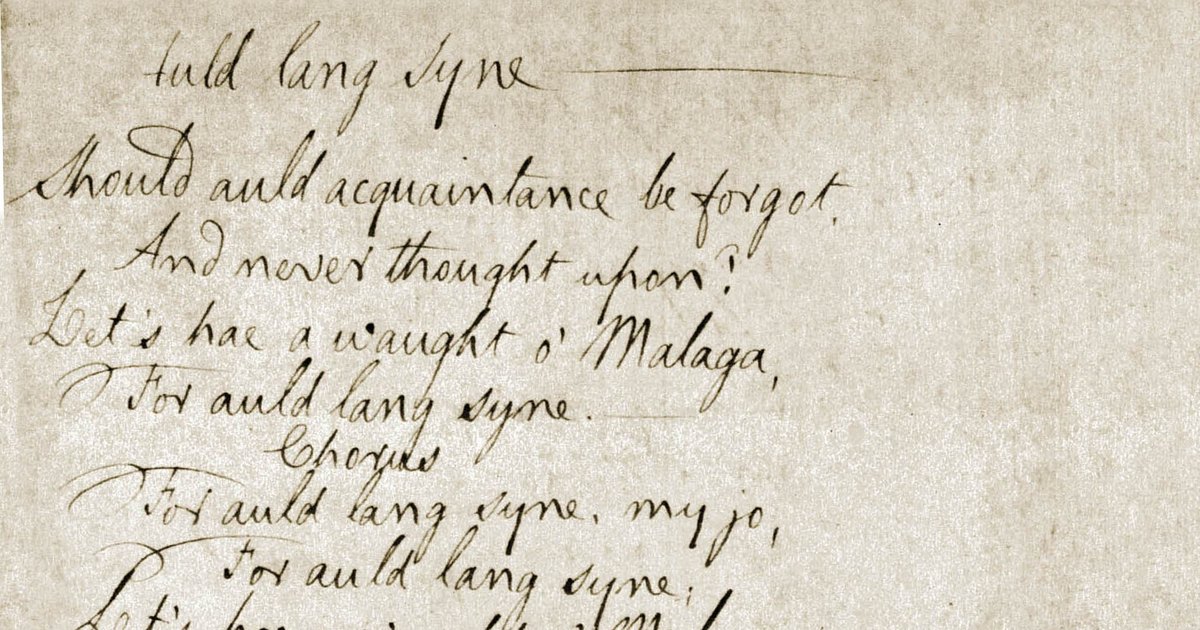
Robert Burns, in 1788, though he said he "took it down from an old man's singing". Songs with the line "should auld acquaintance be forgot" go back to the 1600s, but most scholars believe Burns wrote at least two of the verses himself. Six manuscripts in his handwriting survive, no two alike. The earliest, pictured at the top of this page, has "never thought upon" and "let's hae a waught o' Malaga" where we now sing "never brought to mind" and "a cup o' kindness" (Library of Congress).
Why do we sing Auld Lang Syne on New Year's Eve?
Because it's a song about looking back, and Scots sang it at Hogmanay, their New Year celebration. Emigrants carried the habit abroad, and by 1929 a line from it was displayed on the electronic ticker at the New Year celebrations in Times Square (BBC News). In North America, Guy Lombardo's band then played it on New Year's Eve broadcasts for decades. It was published in 1796, the year Burns died, and matched with the tune we use today in 1799.
Is it "old lang syne" or "auld lang syne"?
"Auld". It's the Scots word for "old", said "awld". People often hear and write "old lang syne" or "old lang zine", but the title and every line use "auld", and "syne" is said "sign".
Get it ready before the 31st
Screenshot the short version at the top of this page, or print a few copies for the table. Sing it through twice this week so the tune and the words are in the same place in your head. Then decide who starts it and whether it comes just before midnight or just after.
For the rest of the night, here's what to play in the minutes around midnight, and if the crowd wants to keep singing afterwards, the karaoke songs everyone knows.