
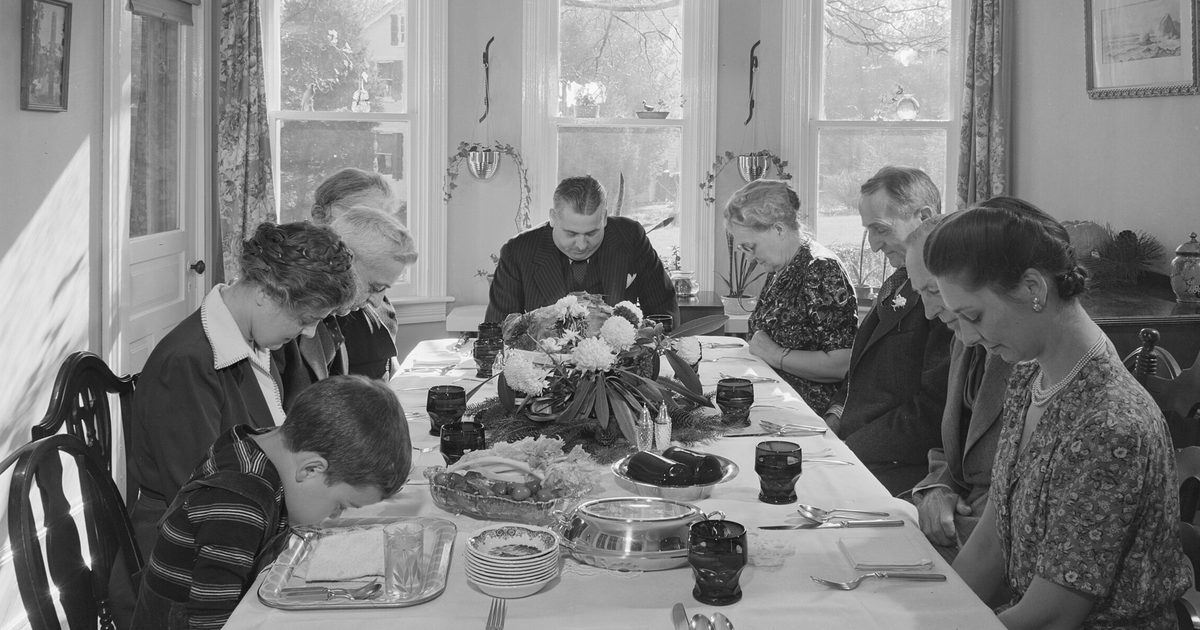
Thanksgiving Grace Songs and Hymns Everyone Can Sing at the Table
Want the whole table to sing grace this Thanksgiving? The sung graces and hymns most families already half-know, the words you can print, a version for kids and for mixed-belief tables, how to start on a note everyone can reach, and how to learn the tunes this week.
The short answer: sing the Doxology tune, one verse, starting low
If you want a whole table of mixed ages to sing grace together, use a tune most of them already know and keep it to one verse. The safest choice in the US is the tune of the Doxology, "Praise God, from whom all blessings flow". Many churchgoers have sung it for years, and it only has four short lines.
Two more that work for almost any Christian family:
- "Be present at our table, Lord", a four-line table grace by John Cennick (1741), sung to that same Doxology tune (Hymnary.org). If your family knows one tune, it knows this grace.
- "For health and strength and daily food", a one-line grace sung as a round (Hymnary.org). Kids love it.
For a full hymn before or after the meal, the American Thanksgiving standard is "We Gather Together". For a mixed table where not everyone prays, "Simple Gifts" is about gratitude without being a prayer.
Then do three things: print the words, let one person start, and pitch it lower than feels natural. A table of untrained voices sings better low than high.
This guide is for whoever is hosting on Thursday, November 26, 2026, or the grandparent who has always wanted the family to sing before the turkey, and who has two weeks to get everyone ready.
The sung graces, with the words
These three are short enough to fit on a place card. The texts are old and in the public domain, so you can print them.
1. The Doxology (Thomas Ken, 1674; tune OLD HUNDREDTH)
Praise God, from whom all blessings flow; Praise Him, all creatures here below; Praise Him above, ye heavenly host; Praise Father, Son, and Holy Ghost.
Thomas Ken, an English bishop, wrote it as the last verse of hymns for the boys at Winchester College. The tune comes from the Genevan Psalter of 1551 and is often credited to Louis Bourgeois (Hymnary.org). Many churches sing it every Sunday at the offering, so someone at your table will probably know it by heart. Some congregations now sing different last lines. If yours does, use those words.
2. "Be present at our table, Lord" (John Cennick, 1741; same tune)
Be present at our table, Lord; Be here and everywhere adored; Thy creatures bless, and grant that we May feast in paradise with Thee.
Cennick, an early Methodist and Moravian preacher, published it in 1741, and it is in more than 60 hymnals, including The United Methodist Hymnal (Hymnary.org). Wording varies: some hymnals print "These mercies bless" in the third line. Use the version your family grew up with.
3. "For health and strength" (traditional round; Dutch tune GRACE)
For health and strength and daily food, We praise Thy name, O Lord.
Hymnary lists it as a traditional table grace, sung to a Dutch folk tune, and several hymnals mark it as a round (Hymnary.org). Sing it once all together. Then split the table in two and have the second half start when the first half reaches "daily food". Two times through is plenty.
Thanksgiving hymns, for before or after the meal
A full hymn is longer than a grace. These work best before you sit down, with everyone standing round the table, or after dessert. Sing the first verse only unless your family really knows them.
| Hymn | Words | Tune | Why it fits |
|---|---|---|---|
| "We Gather Together" | Dutch, printed 1626; English by Theodore Baker, 1894 | KREMSER, a Dutch folk tune | "Traditionally associated with Thanksgiving Day in the United States" (Hymnary.org) |
| "Now Thank We All Our God" | Martin Rinkart, German; English by Catherine Winkworth, 1858 | NUN DANKET, Johann Crüger, 1647 | Rinkart's original title was a "little prayer before the meal" (Hymnary.org) |
| "Come, Ye Thankful People, Come" | Henry Alford, 1844 | ST. GEORGE'S WINDSOR, George Elvey, 1858 | Written for English village harvest festivals (Hymnary.org) |
| "We Plough the Fields and Scatter" | Matthias Claudius, German, 1782; English by Jane Campbell, 1861 | WIR PFLÜGEN, J. A. P. Schulz | A harvest hymn with the refrain "All good gifts around us" (Hymnary.org) |
| "For the Beauty of the Earth" | Folliott S. Pierpoint, 1864 | DIX, Conrad Kocher | Thanks for family, friends and the world; the same tune as "As with Gladness Men of Old" (Hymnary.org) |
Which one, if you only pick one? "We Gather Together" for an American table, because grandparents are the most likely to know it. "Now Thank We All Our God" if your family is Lutheran or German, or if you like the story: it started life as a grace before meals.
A note on "We Gather Together": it was written to celebrate the Dutch winning freedom from Spanish rule, and Hymnary notes its language can sound militant. Its first verse is about gathering and asking for a blessing, which is why it suits the table.
A version for the kids' end of the table
- "For health and strength" as a round. It is one line long, and the round gives kids a job.
- "Thank You for the World So Sweet", a short children's grace by E. Rutter Leatham, in print since at least 1923 (Hymnary.org). Many families say it rather than sing it.
- The "Johnny Appleseed" grace ("Oh, the Lord is good to me"). This is the one many people learned at camp or Sunday school. It is "The Lord Is Good to Me" by Kim Gannon and Walter Kent, from Disney's 1948 Melody Time (D23). It is still under copyright, so we don't print the words here. If your kids know it, it's a great grace.
Let a child start the round or lead the grace. They'll take it seriously, and the adults will follow.
If you are also running music at the kids' class feast that week, Thanksgiving songs for kids has a full circle-time plan.
For a mixed table, where not everyone prays
Plenty of Thanksgiving tables include a devout grandmother, an atheist son-in-law and a friend from another faith. A sung prayer can feel like being asked to sign something.
"Simple Gifts" is the easy answer. It was written by the Shaker elder Joseph Brackett in 1848 (Hymnary.org), and most people know the tune from Aaron Copland's Appalachian Spring, which premiered in 1944 (Aaron Copland). The words are about simplicity and gratitude, and they fit on a card:
'Tis the gift to be simple, 'tis the gift to be free, 'Tis the gift to come down where we ought to be, And when we find ourselves in the place just right, 'Twill be in the valley of love and delight.
Other ways to make room for everyone:
- Say it plainly. "Grandma would like us to sing grace. Join in if you'd like, or just enjoy it." No one minds a song they were invited to, not ordered into.
- Sing first, then go round the table. After the grace, each person says one thing they're thankful for. That part is for everyone.
- Keep it short. One verse, then pass the potatoes.
How to start on a note everyone can reach
This is where a sung grace usually goes wrong. Someone starts too high, and by the third line the men have dropped out and the kids are squeaking.
- Pick one leader. The person who knows the tune best sings the first few words alone, and everyone joins on the next line.
- Start low. Hum the first note, then go a little lower. Speak the first line in your normal voice and start singing at about that pitch. Starting a bit low costs nothing; starting high loses half the table by the last line.
- Steal the first note. Play a recording for two seconds just before, hum the first note, then stop the music and sing. Or have someone with a piano app play it.
- Go slow. Slower than a recording. People need time to read the card.
- One verse. Then sit down, or carve.
If it falls apart, laugh and say the rest of the words. That's still grace.
Learn the tunes this week
The table will sing better if the tune is already in a few people's heads before Thursday.
- Play it in the background while you cook or drive this week, four or five times. You don't need to practise; just hear it.
- Send it ahead. Text the link to the cousins who'll be there, with the words. Teenagers learn a tune from one listen faster than any adult.
- Choose a plain recording. Search the title plus "hymn" or "congregation" and pick a version where a congregation or a simple choir sings it straight. Avoid big concert arrangements, which often change the key, the rhythm or the words.
- Check the words match. Many hymns have been updated over the years. If your printed card says "Thee" and the recording says "you", the table will split.
Setting it up in Trending Music
Trending Music is our app, so weigh this section accordingly. It's free, with ads, and it plays music videos and recordings from a huge catalog, including hymns, choirs and congregational recordings.
- Search for each hymn or grace by title, for example "We Gather Together hymn" or "Doxology Old Hundredth".
- Make a playlist. Tap ••• on a recording, then Add to Playlist, and call it "Thanksgiving grace". Our playlist guide goes through it.
- Loop it while you learn. Swipe up on the player to open the queue, where Repeat sits along the bottom.
- Sing along. If the app finds lyrics for that recording, they show on the Lyrics screen, and the microphone button there turns on Karaoke mode, which turns the lead vocal down so you can hear yourself. Free users get one karaoke song a week. Many hymn recordings won't have lyrics, so print the words.
What it can't do: it can't change the key of a recording, and it won't print the words for you. During grace itself, turn the music off. The free version can show an ad between songs while the app is open, which is the last thing you want at the start of grace.
What is the most popular Thanksgiving hymn?
In the United States, "We Gather Together". Hymnary.org describes it as traditionally associated with Thanksgiving Day in the US. In Britain and Canada, where harvest festival hymns fill the same role, "Come, Ye Thankful People, Come" and "We Plough the Fields and Scatter" are the usual choices.
What is the grace sung to the Doxology tune?
Usually "Be present at our table, Lord", John Cennick's four-line grace from 1741. Because it has the same meter as the Doxology, it fits the same tune, OLD HUNDREDTH. Some families simply sing the Doxology itself as their grace.
Should we have music playing during dinner too?
Yes, but not during grace. Sing first, then start the dinner music once people are passing dishes. Our Thanksgiving dinner music guide has three short playlists, and how loud to play them.
Before Thursday
Pick one grace and one hymn, print the words on cards, send the recording to the family, and decide who starts. That's the whole plan.
If you're spending part of the holiday with a parent who has dementia, hymns they sang as a child are often the songs they still know. Holiday music for a visit with a parent who has dementia shows how to choose them. And if the singing goes well, Christmas is next: caroling songs everyone knows has the ones a whole street can sing.