
Native American Heritage Month Songs: 15 Tracks by Native Musicians, With the Nation and the Story
Planning music for November? Fifteen songs actually made by Native American and First Nations musicians, from 1930s jazz to powwow-step, each with the artist's nation and one fact to say out loud, plus the songs to leave off.
The short answer
November is National American Indian Heritage Month. It began with a joint resolution Congress passed and President George H. W. Bush signed on August 3, 1990 (Public Law 101-343), and presidents have proclaimed it most years since (Congressional Research Service).
The music for it should be made by Native musicians, not songs other people wrote about them. Fifteen that work, in rough order of age:
- "Rockin' Chair", Mildred Bailey (Coeur d'Alene), 1930s jazz
- "Rumble", Link Wray, 1958
- "Witchi Tai To", Jim Pepper (Kaw and Muscogee), 1969
- "The Weight", The Band, written by Robbie Robertson (Cayuga and Mohawk), 1968
- "Come and Get Your Love", Redbone, 1974
- Anything from AKA Graffiti Man, John Trudell with Jesse Ed Davis (Kiowa), 1980s
- Canyon Trilogy, R. Carlos Nakai (Navajo and Ute), 1989
- "NDN Kars", Keith Secola (Ojibwe)
- A powwow song by Northern Cree (Saddle Lake Cree Nation)
- "Indomitable", DJ Shub featuring Northern Cree
- "Electric Pow Wow Drum", The Halluci Nation
- "Prayer Loop Song", Supaman (Apsáalooke)
- "Stand Up / Stand N Rock #NoDAPL", Taboo
- Something from The Land, the Water, the Sky, Black Belt Eagle Scout (Swinomish and Iñupiaq), 2023
- Voiceless Mass, Raven Chacon (Diné), the 2022 Pulitzer Prize in Music
Say the artist's nation and one fact before each track. That one sentence is what turns background music into a lesson.
Who this is for
You are a teacher, librarian or music teacher planning November, a parent who volunteered for the class's heritage-month bulletin board, or the person organizing an observance at work. You searched for "Native American Heritage Month songs" and found lists of anonymous flute tracks with no names, or pop songs written by non-Native songwriters about "Indians". You want real artists, the facts to introduce them, and nothing that will embarrass you in front of a Native family.
If your class is doing Thanksgiving in the same weeks, our Thanksgiving songs for kids guide covers that list, and why "Pilgrims and Indians" songs and costumes are best left out.
Jazz, rock and soul: 1930s to 1970s
Mildred Bailey, "Rockin' Chair". Bailey grew up on the Coeur d'Alene Reservation in Idaho, and her mother was a citizen of the Coeur d'Alene Tribe. Her nicknames included "The Queen of Swing" and "The Rockin' Chair Lady". She was inducted into the Big Band and Jazz Hall of Fame in 1989 (Wikipedia).
Link Wray, "Rumble" (1958). Wray is often credited with bringing the power chord into popular music with this instrumental, and some radio stations refused to play it because the title sounded like a gang fight. The Library of Congress added it to the National Recording Registry in 2008 (Wikipedia)). Wray said his mother was of Shawnee descent; his family appears as white on census records, so say "Wray identified as Shawnee" rather than naming a tribal citizenship (Wikipedia). The song also gave its name to the 2017 documentary Rumble: The Indians Who Rocked the World, which won a special jury award at Sundance (Wikipedia). For high school, it is the obvious follow-up.
Jim Pepper, "Witchi Tai To" (1969). Pepper, of Kaw and Muscogee heritage, was a jazz saxophonist. He built this song from a peyote song of the Native American Church that he learned from his grandfather, and released it with his band Everything Is Everything (Wikipedia). Pepper chose to record and release it, so it is fine to play. Just say where the melody came from.
Robbie Robertson, "The Weight" (1968). Robertson's mother was Cayuga and Mohawk and grew up on the Six Nations of the Grand River reserve in Ontario, where he learned guitar. He wrote "The Weight" with The Band for Music from Big Pink (Wikipedia). Most adults in the room know it, and few know who wrote it.
Redbone, "Come and Get Your Love" (1974). The band's members had Yaqui, Shoshone, Siletz and Mexican roots. The song reached No. 5 on the Billboard Hot 100 and sold over a million copies (Wikipedia)). Kids may know it from Guardians of the Galaxy. For older students, Redbone's "We Were All Wounded at Wounded Knee" (1973), about the 1890 massacre and the 1973 occupation, went to No. 1 in the Netherlands and was banned by several US radio stations. That ban is a discussion in itself.
Jesse Ed Davis and John Trudell. Davis, a Kiowa citizen, played lead guitar on John Lennon's Walls and Bridges and played at the Concert for Bangladesh. In the 1980s he set the poetry of the activist John Trudell to music on AKA Graffiti Man (Wikipedia). Spoken word over rock guitar works well in a high school English class.
Flute, powwow and powwow-step
R. Carlos Nakai, Canyon Trilogy (1989). Nakai is of Navajo and Ute descent. Canyon Trilogy and his earlier Earth Spirit were both certified gold by the RIAA, and he has 11 Grammy nominations (Wikipedia). If you want quiet flute music under a reading or an art lesson, use a named artist like Nakai rather than an unlabeled "Native flute relaxation" video.
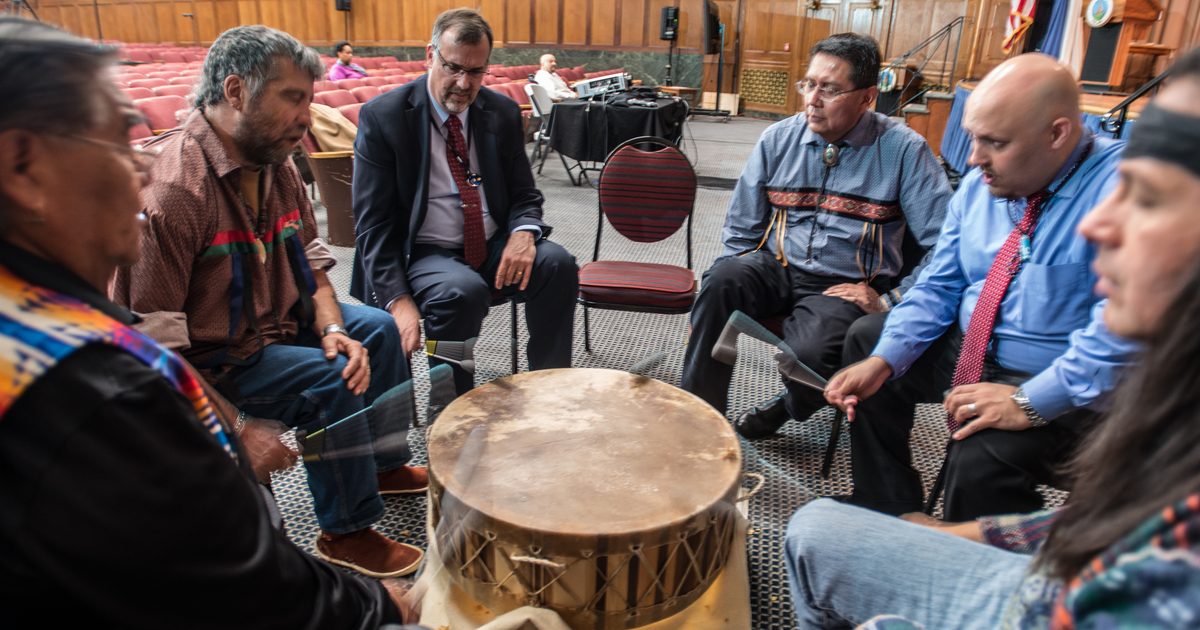
Northern Cree. A powwow and round dance drum group from Maskwacis, Alberta, formed in 1982 by members of the Saddle Lake Cree Nation. They have nine Grammy nominations, and when they performed at the 60th Grammy Awards pre-telecast it was described as the first time traditional Indigenous music was performed on the Grammy stage (Wikipedia). Their albums are recorded and sold for listening, so playing them is fine. Tell the class it is a drum group, that the drum is shared by all the singers, and what a powwow is.
DJ Shub, "Indomitable", featuring Northern Cree. The same singers over electronic beats. Play it straight after a Northern Cree track and ask the class what changed.
The Halluci Nation, "Electric Pow Wow Drum". The group was founded in Ottawa as A Tribe Called Red and renamed itself in 2021. Their style is called powwow-step: powwow drum and vocals inside club music. Members are Cayuga, Mohawk and Ojibwe, and they won the Juno for Breakthrough Group of the Year in 2014 (Wikipedia). Their track "R.E.D." was used on Reservation Dogs.
Hip-hop, indie and a Pulitzer
Supaman, "Prayer Loop Song". Supaman is Christian Parrish Takes the Gun, an Apsáalooke (Crow) rapper and fancy dancer from Crow Agency, Montana, who often performs his raps in his fancy dance regalia (Wikipedia). Students who think of Native culture as something in the past usually change their mind here.
Taboo, "Stand Up / Stand N Rock #NoDAPL". Taboo, of the Black Eyed Peas, has Shoshone heritage from his grandmother. This track, about the Standing Rock protests against the Dakota Access Pipeline, has Supaman in the video, and won the 2017 MTV Video Music Award for Best Video with a Social Message (Wikipedia)). It is political. Use it with older students and a plan for the discussion.
Keith Secola, "NDN Kars". Secola is an Ojibwe musician who won best artist at the 2006 Native American Music Awards (Wikipedia). "NDN Kars" is a funny road song and a good one to end on.
Black Belt Eagle Scout. The project of Katherine Paul, a Swinomish and Iñupiaq singer-songwriter, on the Saddle Creek label. Her third album, The Land, the Water, the Sky, came out in 2023 (Wikipedia).
Raven Chacon, Voiceless Mass. Chacon, a composer from Fort Defiance on the Navajo Nation, won the 2022 Pulitzer Prize for Music for this 16-minute piece for organ and ensemble. He is the first Native American to win that prize (Pulitzer Prizes). It is not easy listening, and that is the point for a music class: play two minutes and ask why a mass might have no voices.
And a poet. Joy Harjo, a citizen of the Muscogee Nation, was the 23rd US Poet Laureate, from 2019 to 2022, and the first Native American in the role. She also plays saxophone, and her album Winding Through the Milky Way won a Native American Music Award (Wikipedia). Hearing her read and play is a natural bridge from a music lesson to English class.
What to leave off the list
Songs about Native people written by people who are not Native. "Indian Reservation (The Lament of the Cherokee Reservation Indian)" was a No. 1 hit for Paul Revere & the Raiders in 1971, but John D. Loudermilk wrote it (Wikipedia)). Songs like this can be useful to study as outsiders' views, but they are not what the month is for.
Unlabeled "Native American music" videos. If you cannot name the performer and their nation, you cannot introduce it, and you have no idea whose music it is.
Ceremonial songs. Some songs are kept for ceremony and not meant for a classroom speaker. Commercial albums like the ones above were released by the artists for anyone to hear. Stick to those.
Buffy Sainte-Marie, for now. She appears on many older lists and co-wrote the Oscar-winning "Up Where We Belong". In 2023 a CBC investigation questioned her claim of Indigenous ancestry, and in January 2025 her appointment to the Order of Canada was terminated. She says the report has mistakes and that she has never lied about her identity (CBC News). For a heritage-month list there are many artists without that question attached.
Also: name the specific nation, not just "Native American". The US alone has more than 570 federally recognized tribes and Alaska Native villages (Bureau of Indian Affairs), and "Navajo and Ute" tells students far more than "Indian".
A 30-minute lesson you can copy
| Minutes | What happens | Track |
|---|---|---|
| 0 to 3 | Ask: "Name a Native American musician." Most classes cannot | None |
| 3 to 8 | Rock started here too | "Rumble", then 30 seconds of "Come and Get Your Love" |
| 8 to 14 | The drum | A Northern Cree song, then "Indomitable" |
| 14 to 20 | Now | "Prayer Loop Song" or "Electric Pow Wow Drum" |
| 20 to 27 | Write: "Which track surprised you, and why?" | Canyon Trilogy, low |
| 27 to 30 | Share | "NDN Kars" as they pack up |
For younger kids, keep the drum section and "Come and Get Your Love", and let them move. For high school, add Voiceless Mass and the Redbone Wounded Knee song.
For better background than any playlist, the Smithsonian's National Museum of the American Indian runs Native Knowledge 360°, free lessons and teaching materials for every grade. The federal heritage month site lists this year's Library of Congress and Smithsonian events. Playing recorded music in face-to-face teaching at a nonprofit school is generally covered by US copyright law (17 U.S.C. 110(1)), but check your school's own rules on phones and streaming.
Building it in Trending Music
Trending Music is our app, so weigh this section accordingly. You can search for and play these songs in it free, and build the playlist in the lesson order.
- Make the playlist. Search for the first song, tap the ••• on its row (or press and hold the row), choose Add to Playlist, then New Playlist, type a name and tap Create. For every song after that, choose Add to Playlist and pick it under Your Playlists.
- Write the facts in your notes, not the app. The app shows the artist name, not the artist's nation or story. That part is yours.
- Turn off Autoplay in Settings, then Playback. Otherwise the app keeps playing similar music when your list ends, and that music has not been checked.
What it cannot do. Lyrics are not available for every song, and there is no clean-version filter, so listen through anything you have not heard. We did not check that every recording above is in the app. If one is missing, search the artist's name or play it from their label's site. And the free version is supported by ads, which can appear when a new song starts. In front of a class, do a run-through the night before, keep the phone in your hand, or use Premium, which removes ads.
When is Native American Heritage Month 2026?
All of November: Sunday, November 1 to Monday, November 30, 2026. It has been observed in November since the 1990 joint resolution (Public Law 101-343), sometimes under the name National American Indian Heritage Month.
Is it OK to play powwow music in a classroom?
Yes, if it is a commercially released recording by a named drum group like Northern Cree, and you introduce the group and their nation. Those albums are made for listening. Avoid unlabeled videos and anything described as a ceremonial song.
Before November 1
Pick six songs from the list, write one sentence about each artist on an index card, and listen to all six the night before. Then build the playlist and turn off Autoplay.
Veterans Day falls inside the same month, on Wednesday, November 11. If your school holds an assembly, our Veterans Day songs for a ceremony has a full running order. For the Thanksgiving week, Thanksgiving songs for kids is the classroom list, and if a winter concert is next, here is how to help kids learn the songs at home.