
Veterans Day Songs: Music for a School or Community Ceremony
Running the music for a Veterans Day assembly or ceremony? The cue sheet, the Armed Forces Salute, Taps, songs that fit, and the lyrics that don't.
The short answer
A Veterans Day ceremony has six music moments, and only two of them are hard:
- Prelude (10 to 15 minutes before): patriotic marches at low volume while people find seats.
- National anthem: live if you have a singer or choir, otherwise one plain recording.
- Armed Forces Salute: the six service songs in a medley. Veterans stand when they hear their branch's song. This is the moment people remember.
- Tribute song: one song performed or played for the veterans, such as "God Bless the U.S.A." or "America the Beautiful".
- Taps: during the moment of silence or the wreath. Use a live bugler if you possibly can.
- Closing: a song everyone can sing, usually "God Bless America", then marches as people leave.
Then three practical things: check that your Armed Forces medley includes all six branches, play every lyric start to finish, and never run the ceremony from an app that can put an ad between songs.
Who this is for
You are the music teacher, the PTA volunteer, the assistant principal, or the American Legion or VFW member who got handed "the music" for the Veterans Day program. Veterans Day 2026 is Wednesday, November 11. If your district closes that day, the school assembly is usually the day before.
Real veterans will be in the front rows, some of them in uniform, and some of them will be your students' grandparents. You want it to feel right to them, and you do not want a silence or a wrong song in the middle of it.
One distinction shapes every choice below. Veterans Day thanks everyone who served, most of them still living. Memorial Day honors those who died in service. Many popular "military songs" are about the fallen, and they belong to May more than to November.
A cue sheet you can copy
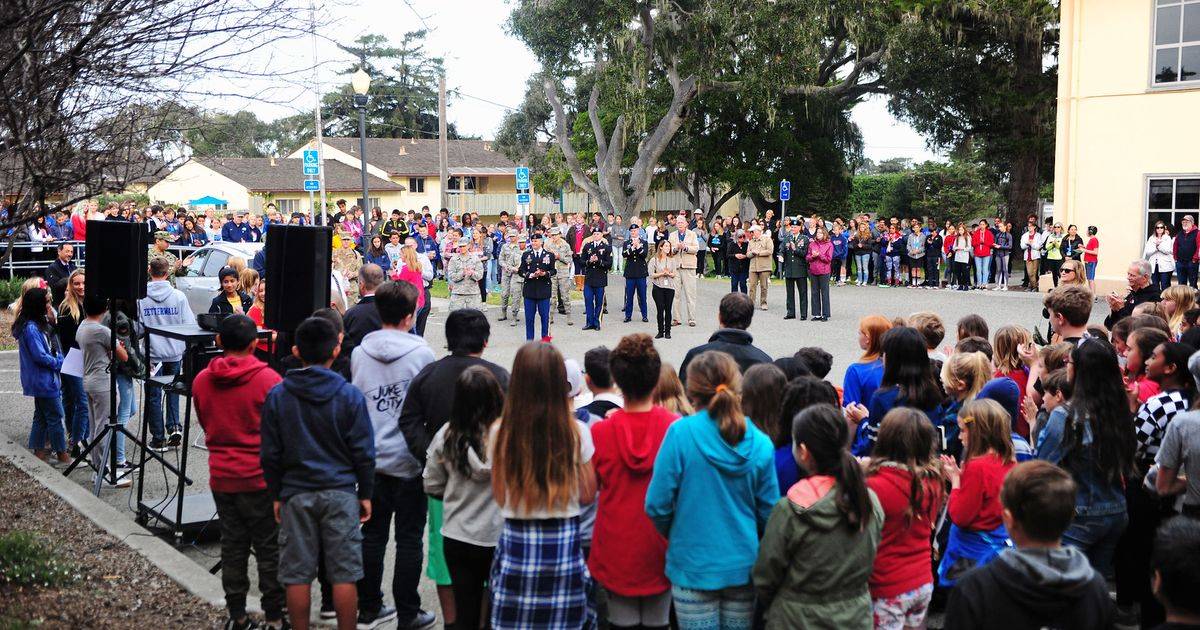
Most school and community ceremonies run 30 to 45 minutes. This is the order most of them follow. Print it, and give a copy to whoever presses play.
| Cue | Music | Notes |
|---|---|---|
| Prelude | Marches, instrumental patriotic songs | Low volume, on shuffle, stops when the emcee walks up |
| Presentation of the colors | Silence, or a march | Ask the color guard leader which they prefer |
| Pledge of Allegiance | None | |
| National anthem | Live, or one recording | Everyone stands |
| Welcome and speaker | None | Mute the playlist completely |
| Armed Forces Salute | Service songs medley | Veterans stand for their branch |
| Student or choir tribute | One or two songs | Rehearse with the exact track |
| Moment of silence or wreath | Taps | Live bugler first, recording as backup |
| Closing | "God Bless America" | Put the lyrics in the program |
| Retiring of the colors | Silence, or a march | |
| Postlude | Marches | Until the room clears |
If the ceremony can be timed so the moment of silence lands at 11:00 a.m., do it. The armistice that ended the fighting in World War I took effect at the eleventh hour of the eleventh day of the eleventh month, which is why Veterans Day is November 11.
The Armed Forces Salute
This is the medley of the official songs of each branch. The emcee says something like "Veterans, please stand when you hear the song of your branch, and remain standing", and the music does the rest. It is the moment veterans talk about afterwards.
The six songs:
- Army: "The Army Goes Rolling Along"
- Marine Corps: "The Marines' Hymn"
- Navy: "Anchors Aweigh"
- Air Force: "The U.S. Air Force", the one most people know as "Off we go into the wild blue yonder"
- Space Force: "Semper Supra"
- Coast Guard: "Semper Paratus"
Check your recording has all six. The Space Force song was released in September 2022, so most older medleys stop at five. If a Space Force veteran or Guardian is in the room and their song never comes, they notice. Many arrangements play the branches in the order above, which is the official order of precedence, but recordings vary. Write down the order your recording actually uses and put it in the printed program.
Search for "Armed Forces Medley" or "Armed Forces Salute" and pick a recording by a military band, such as the U.S. Army Band "Pershing's Own" or the U.S. Marine Band "The President's Own". They are played at the tempo veterans expect, and they do not open with a minute of applause. National Guard and Reserve veterans stand with their branch.
Taps, done properly
Taps is a 24-note bugle call, about a minute long. At a Veterans Day ceremony it is played during the moment of silence or after the wreath is placed, and everyone stands in silence.
- A live bugler is far better than a recording. Ask the high school band director for a strong trumpet student, or contact Bugles Across America, a volunteer group of buglers who play at military funerals and ceremonies. Ask early: buglers are in demand that week.
- Keep a recording ready anyway. Cold lips and nerves happen. Have one plain recording of Taps queued on its own, so you can play it with one tap if the bugler cannot start.
- Do not use Taps as background music. Not under a slideshow, not in the prelude, not mixed into a medley. It is a ceremonial call, and veterans will notice.
During the national anthem, veterans and service members who are not in uniform may give the military salute instead of placing a hand over the heart. US law has allowed this since 2008. It is worth a line in the program, because some veterans still are not sure they can.
Songs that fit Veterans Day
For everyone to sing
- "The Star-Spangled Banner"
- "America the Beautiful", and Ray Charles's recording if you want one to play
- "God Bless America" by Irving Berlin
- "My Country, 'Tis of Thee"
- "This Land Is Your Land" by Woody Guthrie
- "You're a Grand Old Flag" by George M. Cohan, a favorite for younger grades
- "Battle Hymn of the Republic"
Tribute songs for living veterans
- "God Bless the U.S.A." by Lee Greenwood. Many people know it as "Proud to Be an American"; it is the same song.
- "American Soldier" by Toby Keith
- "Letters from Home" by John Michael Montgomery
- "Where the Stars and Stripes and the Eagle Fly" by Aaron Tippin
- "Some Gave All" by Billy Ray Cyrus
Instrumentals for the prelude, a slideshow or the postlude
- "The Stars and Stripes Forever" by John Philip Sousa
- "Semper Fidelis" by John Philip Sousa
- "Ashokan Farewell" by Jay Ungar, the slow fiddle tune from Ken Burns's The Civil War
- Any of the service songs above, played by a military band
For a moment that remembers those who died
If the ceremony also reads the names of local veterans who died this year, one of these can go there. Keep it to that moment.
- "Arlington" by Trace Adkins
- "If You're Reading This" by Tim McGraw
- "Amazing Grace", ideally on bagpipes
Listen to every lyric first
Most music mistakes at a Veterans Day program come from songs that sound patriotic and are not, or are not meant for a school.
- "Born in the U.S.A." by Bruce Springsteen sounds like a celebration and is a bitter song about a Vietnam veteran coming home to no job and no help. Some veterans love it for exactly that reason, but it is not a thank-you. More on why in our rock songs guide.
- "Fortunate Son" by Creedence Clearwater Revival is a protest song about wealthy families keeping their sons out of the draft. Great song, wrong ceremony.
- "Courtesy of the Red, White and Blue (The Angry American)" by Toby Keith has a line about putting "a boot in your ass". Fine at a bar, not in an elementary school gym.
- "Travelin' Soldier" by The Chicks ends with the soldier's name read among the dead. It is beautiful and heavy, and it will upset younger children.
- Check the version, not just the title. A live recording can open with crowd noise, a "patriotic remix" can add sound effects, and an anthem performance at a stadium may run twice as long as the version your choir practiced. Play the exact track you will use, in the app you will use.
For a choir, search for "instrumental" or "karaoke" versions so the kids sing over the accompaniment, not over another singer.
Playing it yourself, without a mistake
In a gym, a cafeteria or a park, you are the sound system. Set it up so nothing depends on you remembering anything in the moment.
- Turn on Do Not Disturb. Open Control Center, tap Focus, then Do Not Disturb. A ringtone during Taps is the mistake people remember.
- Stop the screen locking: Settings > Display & Brightness > Auto-Lock > Never, and plug the phone in. Change it back afterwards.
- Use a cable to the PA if you can. Bluetooth is fine for the prelude, but a cable will not drop in the middle of the anthem. If you must use Bluetooth, pair the speaker the day before and make sure nobody else's phone is still connected to it.
- Make one playlist per cue, named in order: "1 Prelude", "2 Anthem", "3 Armed Forces Salute", "4 Tribute", "5 Taps backup", "6 Closing", "7 Postlude". Then you only ever tap one thing, and nothing runs on into the speaker's remarks.
- Make sure nothing plays after the last song of each playlist. Many apps continue with "similar" music when a playlist ends. Turn that off.
- Sound-check in the actual room. A gym echoes, so set the volume lower than feels right with the room empty, then raise it a little once it fills. Outdoors, wind takes the top end, so stand where the veterans will sit. If the music still seems too quiet, our guide to making music louder on iPhone covers the usual causes.
- Keep the phone warm outdoors. Cold drains an iPhone battery fast. Keep it in a pocket until you need it, and bring a battery pack.
- Give the cue sheet to one person whose only job is the music. They watch the emcee, not the program.
Building it in Trending Music
Trending Music is our app, so weigh this section accordingly. You can search for every song above, including military band recordings of the service songs, and build the playlists for free.
- Make the cue playlists. In the Library tab, open Playlists and tap +. Our guide to making a playlist on iPhone has the steps.
- Let the other teachers add songs. Choose New Collaborative instead and send the link to the staff group chat, so the choir director can add the exact version the kids rehearsed. How collaborative playlists work covers the rest.
- Add your own recordings. If the band director recorded Taps, or you have the choir's rehearsal track as a file, Local Music in the Library tab imports audio files from the Files app.
- Turn off Autoplay in the app's Settings > Playback. It is on by default and keeps similar music going when a playlist ends, which is exactly what you do not want after the anthem.
One honest catch, and it matters here. The free version of Trending shows full-screen ads between songs once you have been listening for a while, and the music pauses until someone closes the ad. In rehearsal that is a few seconds of annoyance. In front of a row of veterans it is not acceptable. For the ceremony itself, use Premium, which removes every ad, or whichever paid music service your school already uses. The cue-playlist plan works in any app.
What songs are played at a Veterans Day ceremony?
Most ceremonies use the national anthem, the Armed Forces Salute (a medley of the six service songs, with veterans standing for their branch), Taps during a moment of silence, and "God Bless America" or "America the Beautiful" to close. Popular tribute songs include "God Bless the U.S.A." by Lee Greenwood and "American Soldier" by Toby Keith.
What are the songs in the Armed Forces Medley?
"The Army Goes Rolling Along" (Army), "The Marines' Hymn" (Marine Corps), "Anchors Aweigh" (Navy), "The U.S. Air Force" (Air Force), "Semper Supra" (Space Force) and "Semper Paratus" (Coast Guard). Recordings made before September 2022 usually leave out the Space Force song.
Is Taps played on Veterans Day?
Often, yes. Taps is played during the moment of silence or after a wreath is laid, while everyone stands. A live bugler is preferred; keep a plain recording ready as a backup in case the bugler cannot play.
Outside the US: Remembrance Day
In Canada, the UK and other Commonwealth countries, November 11 is Remembrance Day, and the music is different. The bugle call is "The Last Post", followed by a period of silence at 11:00 a.m. and then "Reveille" or "The Rouse", and "In Flanders Fields" by John McCrae is usually read rather than sung. The same rules apply: a live bugler if you can, a recording ready if you cannot.
Before November 11
Book the bugler this week. Find an Armed Forces medley with all six branches and write down its order. Play every lyric. Then make one short playlist per cue, and hand the cue sheet to someone whose only job is the music.