
Kwanzaa Songs: Music for Each of the Seven Principles and the Karamu
Planning a Kwanzaa celebration at home or for a group? Songs matched to each night's principle, from Umoja on December 26 to Imani on January 1, music for the December 31 karamu, and what the official Kwanzaa guidance says about mixing in Christmas songs.
The short answer
Kwanzaa runs from Saturday 26 December 2026 to Friday 1 January 2027, and each day is given to one of the seven principles, the Nguzo Saba. The easiest way to plan the music is the same way: two or three songs a night that say something about that night's principle, played around the candle lighting, and a longer party playlist for the karamu feast on 31 December.
| Day | Principle | Songs that fit |
|---|---|---|
| Sat 26 Dec | Umoja (Unity) | "Lift Every Voice and Sing", "We Are Family" |
| Sun 27 Dec | Kujichagulia (Self-Determination) | "Say It Loud – I'm Black and I'm Proud", "To Be Young, Gifted and Black" |
| Mon 28 Dec | Ujima (Collective Work and Responsibility) | "Lean on Me", "Wake Up Everybody" |
| Tue 29 Dec | Ujamaa (Cooperative Economics) | "Ain't No Stoppin' Us Now", a Motown hour |
| Wed 30 Dec | Nia (Purpose) | "A Change Is Gonna Come", "Keep Your Head to the Sky", "Glory" |
| Thu 31 Dec | Kuumba (Creativity), and the karamu | "Sir Duke", then "Before I Let Go", "Pata Pata", "Jerusalema" |
| Fri 1 Jan | Imani (Faith) | "Optimistic", "Rise Up", "Lift Every Voice and Sing" to close |
There is no fixed list of official Kwanzaa songs. The holiday's founder describes the celebration as including "feasts (karamu), music, dance, poetry, narratives" (Official Kwanzaa Website), and leaves the songs to the family. The list above is our suggestion, with the reasoning for each night below so you can swap in your own.
Who this is for
This is for the person putting the week together: a parent hosting Kwanzaa at home for the first time, a grandparent who wants the kids to know what each candle means, a church, community centre or Black student union planning one evening, or a teacher building a Kwanzaa lesson in December.
It's a music plan, not a guide to the ritual. The candle lighting, libation and the order of the evening are your family's or your organisation's to lead, and the Official Kwanzaa Website, kept by the holiday's founding organisation, explains them in detail.
How the music fits a Kwanzaa evening
Kwanzaa was created by Dr. Maulana Karenga in 1966 (Official Kwanzaa Website FAQ). The name comes from the Swahili phrase "matunda ya kwanza", "first fruits", and the seven days follow the seven principles. Each evening, a household greets each other with "Habari gani?" (roughly "What's the news?"), answers with that day's principle, and lights a candle on the kinara (Official Kwanzaa Website).
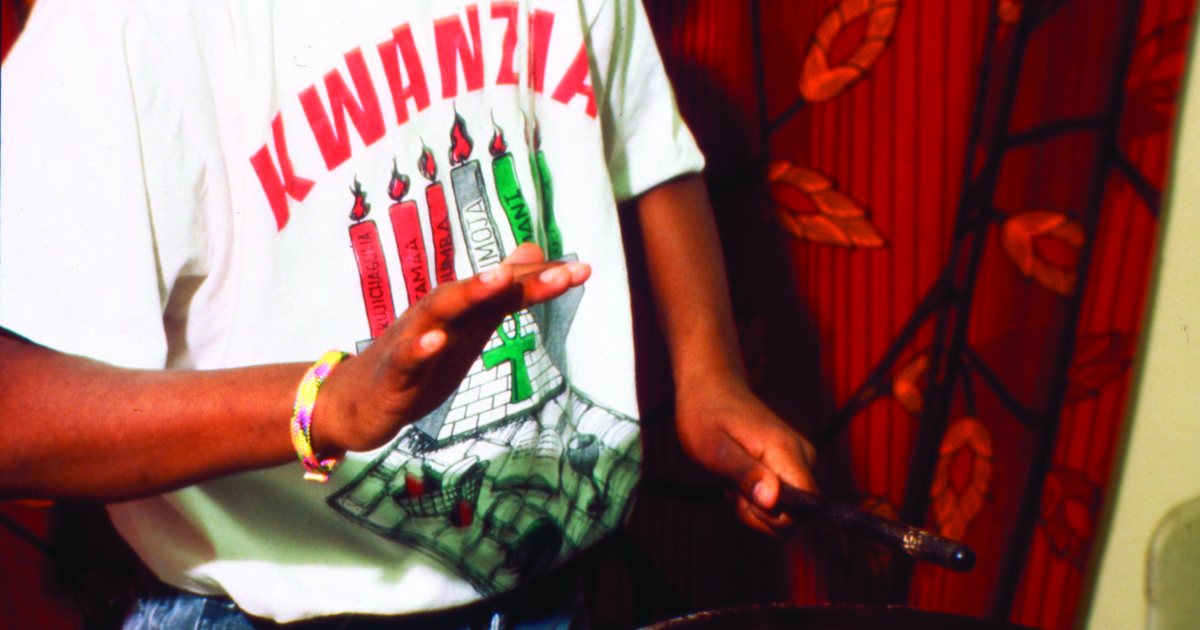
The black candle in the centre, for Umoja, is lit first on 26 December. The founding organisation says the remaining candles are lit "from left to right on the following days": three red ones on the left for Kujichagulia, Ujamaa and Kuumba, three green ones on the right for Ujima, Nia and Imani (Official Kwanzaa Website).
A simple shape that works for a family evening:
- Before: the night's songs quietly while people arrive.
- Candle lighting and the principle: music off. Someone explains the principle, or a child reads it from the Nguzo Saba poster.
- After: play the night's two or three songs properly, and ask one question about the lyrics. "What is Bill Withers asking his friends to do?" gets more out of a ten-year-old than a definition does.
The official site encourages children to "make dramatic, musical and dance presentations" at home or at school (Official Kwanzaa Website). Letting a child pick, introduce and play one song a night is an easy way to do that.
Umoja and Kujichagulia: 26 and 27 December
Umoja (Unity) is "to strive for and maintain unity in the family, community, nation, and race" (Official Kwanzaa Website). It is the first night, so open the week with a song people can sing together.
- "Lift Every Voice and Sing", words by James Weldon Johnson, music by his brother J. Rosamond Johnson. It was first performed in 1900, and the NAACP called it the "Negro national anthem" from 1919; today it's often called the Black national anthem (Wikipedia). Print the first verse; most people know the opening and fade after it.
- "We Are Family", Sister Sledge, written by Bernard Edwards and Nile Rodgers, 1979 (Wikipedia). Four sisters singing about family. The kids will dance to it.
- "Sweet Mother", Prince Nico Mbarga and Rocafil Jazz, a 1976 Nigerian highlife song about a mother's care (Wikipedia). A good choice if your family has West African roots or wants music from the continent alongside the American songs.
Kujichagulia (Self-Determination) is "to define ourselves, name ourselves, create for ourselves and speak for ourselves" (Official Kwanzaa Website).
- "Say It Loud – I'm Black and I'm Proud", James Brown, 1968. It held number one on the R&B chart for six weeks (Wikipedia). Kids pick up the call-and-response chorus by the second time round.
- "To Be Young, Gifted and Black", Nina Simone, 1969, also recorded by Aretha Franklin on her 1972 album of the same name (Wikipedia). A quieter song for after the candle.
Ujima and Ujamaa: 28 and 29 December
Ujima (Collective Work and Responsibility) is "to build and maintain our community together and make our brother's and sister's problems our problems and to solve them together" (Official Kwanzaa Website).
- "Lean on Me", Bill Withers, 1972, a number one on both the soul and Hot 100 charts (Wikipedia). Almost the principle word for word, which makes it the easiest song of the week to explain to young children.
- "Wake Up Everybody", Harold Melvin & the Blue Notes, 1975, written by John Whitehead, Gene McFadden and Victor Carstarphen (Wikipedia). It calls on teachers, doctors and builders to each do their part.
Ujamaa (Cooperative Economics) is "to build and maintain our own stores, shops and other businesses and to profit from them together" (Official Kwanzaa Website). This is the hardest night to find songs for, so tell a story with the music instead.
- "Ain't No Stoppin' Us Now", McFadden & Whitehead, 1979. The duo had spent years writing hits for other people before they wrote and produced this one for themselves (Wikipedia).
- A Motown hour. When Berry Gordy needed $800 to start his label, he borrowed it from a cooperative family savings account (Wikipedia). Tell the kids that, then play the Supremes, the Temptations and Stevie Wonder. It's Ujamaa as a story they will remember.
Another way to keep this night: buy an album or merch from a local Black musician and play that.
Nia: 30 December
Nia (Purpose) is "to make our collective vocation the building and developing of our community in order to restore our people to their traditional greatness" (Official Kwanzaa Website). It's a night for songs about where you're going.
- "A Change Is Gonna Come", Sam Cooke, first released in 1964 (Wikipedia). Slow and serious, good straight after the candle.
- "Keep Your Head to the Sky", Earth, Wind & Fire, 1973 (Wikipedia).
- "Glory", Common and John Legend, the 2014 theme from the film Selma about the 1965 Selma to Montgomery marches (Wikipedia). For teenagers, it's a way into what "purpose" meant for that generation. It includes rap verses, so listen through once before playing it to young children.
Kuumba and the karamu: 31 December
Kuumba (Creativity) is "to do always as much as we can, in the way we can, in order to leave our community more beautiful and beneficial than we inherited it" (Official Kwanzaa Website). It falls on 31 December, the evening many families and communities hold the karamu, Kwanzaa's feast (Wikipedia). So the music has two jobs: a song for the principle, then a party.
For the principle: "Sir Duke", Stevie Wonder, from Songs in the Key of Life (1976), written in tribute to Duke Ellington (Wikipedia). A song about musicians who made something lasting, which is Kuumba. Better still, ask everyone to bring a performance: a poem, a song, a drum piece. The founding organisation describes the celebration's joy through "poetry, dancing, singing, drumming and other music and feasting" (Official Kwanzaa Website).
For the karamu, a party playlist that crosses generations and the diaspora:
- "Before I Let Go", Maze featuring Frankie Beverly, 1981, written and produced by Beverly (Wikipedia). The cookout and family-reunion song. Everyone over 30 will get up.
- "Pata Pata", Miriam Makeba, 1967, her signature South African dance hit (Wikipedia).
- "Jambo Bwana", Them Mushrooms, 1982, a Kenyan pop song in Swahili (Wikipedia). Swahili is the language of Kwanzaa's greetings and principles, so it's a natural fit. The chorus is easy to learn.
- "Malaika", the Swahili love song written by Adam Salim in 1945 and first recorded by Fadhili William (Wikipedia). Miriam Makeba's version is the one many people know. A slow one for later in the evening.
- "Jerusalema", Master KG featuring Nomcebo, 2019, sung in Zulu (Wikipedia). The dance challenge that went round the world in 2020; the teenagers will probably teach it to the elders.
Then add your family's own dance music, whatever gets the uncles up.
If your karamu runs past midnight into New Year's Day, keep one quiet song back for the turn of the year and the Imani candle.
Imani: 1 January
Imani (Faith) is "to believe with all our heart in our people, our parents, our teachers, our leaders and the righteousness and victory of our struggle" (Official Kwanzaa Website). The official site describes the last day as one "dedicated to reflection and recommitment to The Seven Principles" (Official Kwanzaa Website), so keep the music calmer than the night before.
- "Optimistic", Sounds of Blackness, 1991, written and produced by Gary Hines, Jimmy Jam and Terry Lewis (Wikipedia).
- "Rise Up", Andra Day, 2015 (Wikipedia).
- "Lift Every Voice and Sing" again, to close the week where it began. Children who stumbled over the words on 26 December usually know the first verse by now.
Can you play Christmas songs at a Kwanzaa celebration?
Many families celebrate both holidays, and the founding organisation says Kwanzaa "was not created to give people an alternative to their own religion or religious holiday" (Official Kwanzaa Website FAQ).
But it asks people not to blend the two in the celebration itself: "you should not mix the Kwanzaa holiday or its symbols, values and practice with any other culture" (Official Kwanzaa Website). For the music, that means keeping a separate Kwanzaa playlist and saving the Christmas songs for Christmas. If you're putting on one December event that covers several holidays, give Kwanzaa its own segment with its own songs rather than one shuffled list.
Planning Kwanzaa music for a school or a group
The founder's answer on who can take part is useful for teachers. Kwanzaa is "an African holiday created for African peoples," but others can and do take part, and public settings like schools can hold celebrations that include everyone. He adds: "particular people should always be in control of and conduct their own celebrations. Audience attendance is one thing; conducting a ritual is another" (Official Kwanzaa Website FAQ).
In practice:
- Invite someone who celebrates Kwanzaa to lead the candle lighting, such as a parent, a local Kwanzaa committee, or a Black cultural organisation. Your job is to set up the room and the music.
- Use one principle per song in class. Play "Lean on Me", read the Ujima definition, and ask what the class could solve together. That works whether or not anyone in the room celebrates.
- Check for clean versions before playing anything to young students. Most songs here are radio-friendly as released. Listen through "Glory" first because of its rap verses.
- Mind the dates. Kwanzaa starts on 26 December, when most schools are on break, so a school lesson is usually a preview in the week before.
- Ask about music rights for a public event. If it's a ticketed community event or in a hall, ask the venue what music it's licensed to play. Our guide to playing music in a shop or business explains why a personal music app doesn't cover public performances.
Setting it up in Trending Music
Trending Music is our app, so weigh this section accordingly. It's free, and it handles the two jobs here: a short playlist for each night and a long one for the karamu.
- Make one playlist per night, named after the principle, such as "Umoja – Dec 26". Search each song, tap •••, then Add to Playlist. Our playlist guide goes through it step by step.
- Make a separate karamu playlist with the dance songs above plus your family's favourites. If cousins are bringing their own picks, make it collaborative instead: in Library > Playlists, tap + and choose New Collaborative (hosting one needs a free Trending account), then send the invite link to the family group chat so everyone can add songs before the 31st. How collaborative playlists work covers the rest.
- Use the Lyrics tab in the player to read along with "Lift Every Voice and Sing" or "Lean on Me". Lyrics show when they're available for that recording; not every version has them, so print the first verse of "Lift Every Voice" for the first night.
One honest catch: the free version shows an occasional full-screen ad between songs, and the music pauses while it's up. That's fine during the karamu, but don't run a playlist through the candle lighting. That part should be quiet anyway. Premium removes the ads, and if your family already uses Spotify or Apple Music, the same song lists work there.
When is Kwanzaa 2026?
From Saturday 26 December 2026 to Friday 1 January 2027. Kwanzaa always runs from 26 December to 1 January, one principle a day, starting with Umoja and ending with Imani (Wikipedia). The karamu feast is usually held on 31 December.
Are there official Kwanzaa songs?
No. The official site lists music, along with dance, poetry and narratives, as part of the celebration but doesn't prescribe a song list (Official Kwanzaa Website). Families and communities choose their own. "Lift Every Voice and Sing" is a common choice for opening and closing the week, and many celebrations include live drumming.
The rest of the season
If your December also includes Hanukkah, Hanukkah songs for the candle lighting and the party follows the same night-by-night idea. For a December school or office party that needs music with no holiday in it at all, winter songs that aren't Christmas songs has a checked list. And when the karamu is over and you want more from the same shelf, the best 70s songs picks up a lot of the soul and funk above.